Test the spark of a story
Many promising manuscripts stall around page forty because what looked like a complete plot in the notebook was actually an intriguing situation. A situation is a static arrangement of mood, place, and occupation: an archivist Catalogues flooded parish registries on a tidal island. Nothing in that sentence forces tomorrow to look any different from today.
A story concept emerges the moment an unstable element enters that room and makes neutrality impossible: an archivist Cataloguing flooded parish registries discovers her own birth entry recorded twelve years before she was born, signed by the magistrate arriving on tomorrow’s ferry. Now time has an edge, and every conversation carries risk.
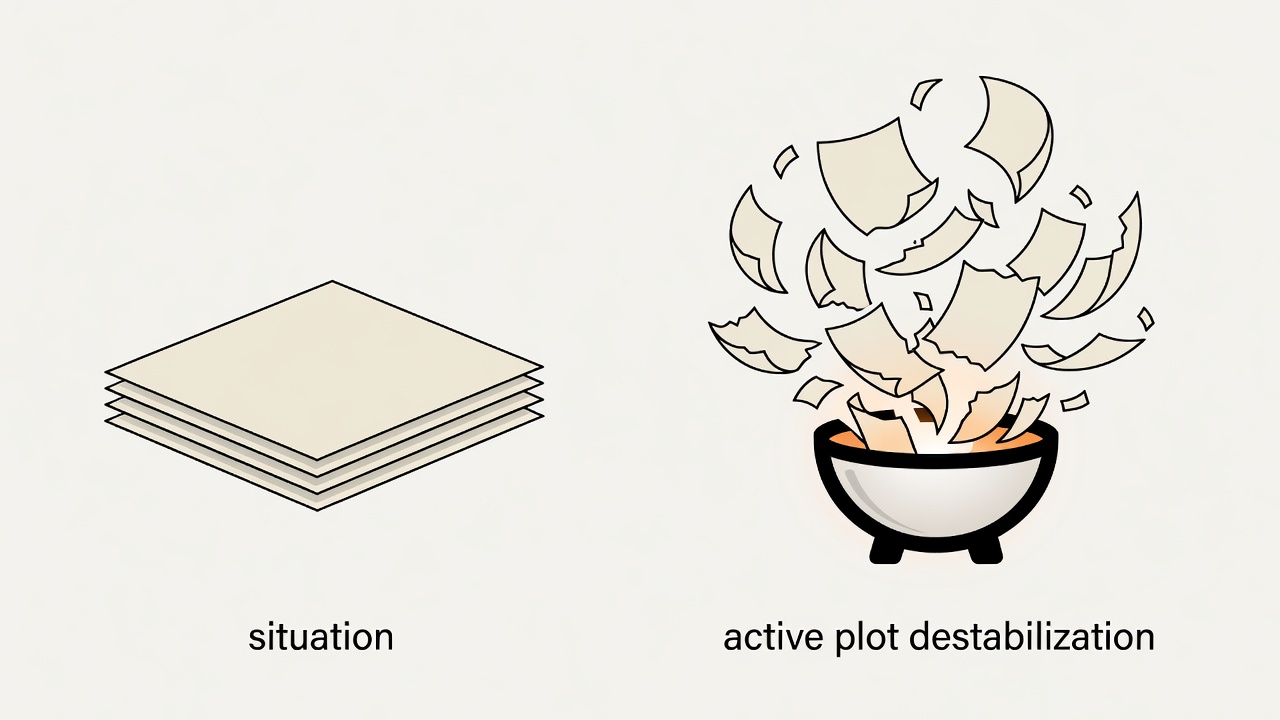
Separating setting lore from narrative engine
In both literary fiction and speculative genres, writers often build elaborate histories before testing what the protagonist actually does during a typical ten-minute scene. When John Gardner wrote about the “vivid and continuous dream” in The Art of Fiction, he emphasized that readers stay inside a story because concrete actions trigger concrete consequences.
To test whether your spark can sustain a short story or a novel, run your working concept through four structural questions before committing to a full outline.
| Workshop Element | Static Situation (Low Friction) | Active Concept Engine (High Friction) |
|---|---|---|
| Protagonist Role | An observer who documents events from a safe distance. | A participant whose silence or intervention directly harms an ally. |
| Setting Function | Atmospheric backdrop explained through introductory paragraphs. | A jurisdictional or physical boundary that restricts easy escape. |
| Time Horizon | Open-ended reflection over an unspecified season. | Anchored to an approaching audit, departure, thaw, or ceremony. |
| Cost of Refusal | The character can walk away and return to normal life. | Walking away forfeits the exact relationship or standing they value most. |
Choosing a plot shape that fits the question
Not every narrative problem requires a loud confrontation. Comparing classical Western tension arcs with East Asian four-act juxtaposition helps clarify why a draft feels either overly mechanical or aimless.
In Gustav Freytag’s 1863 study Die Technik des Dramas, dramatic action rises through complication toward a decisive reversal. When a mystery or thriller loses momentum, it is usually because the antagonist has stopped adapting to the protagonist’s moves. By contrast, stories built around variations on Kishōtenketsu—introduction (ki), development (shō), twist or unassociated shift in perspective (ten), and reconciliation (ketsu)—generate resonance by placing two apparently separate routines side by side until the third movement reframes them both.
“Do not ask whether your plot follows a universal template; ask whether the reader can feel the weight of what changes between the opening image and the closing line.” Margin Workshop Note · Structural Alignment
How to ask a concept question without burying your reader
When you discuss a story concept with a trusted peer, avoid sending five pages of chronological summary. A sprawling synopsis exhausts the responder’s attention before they reach the real knot. Instead, compress the setup into three functional parts:
Once your concept has a clear engine, the next step is verifying that the people inside the story have personal reasons to resist it. Continue to Put Motivation Under Pressure or prepare your own query using our Craft Question Dossier builder.